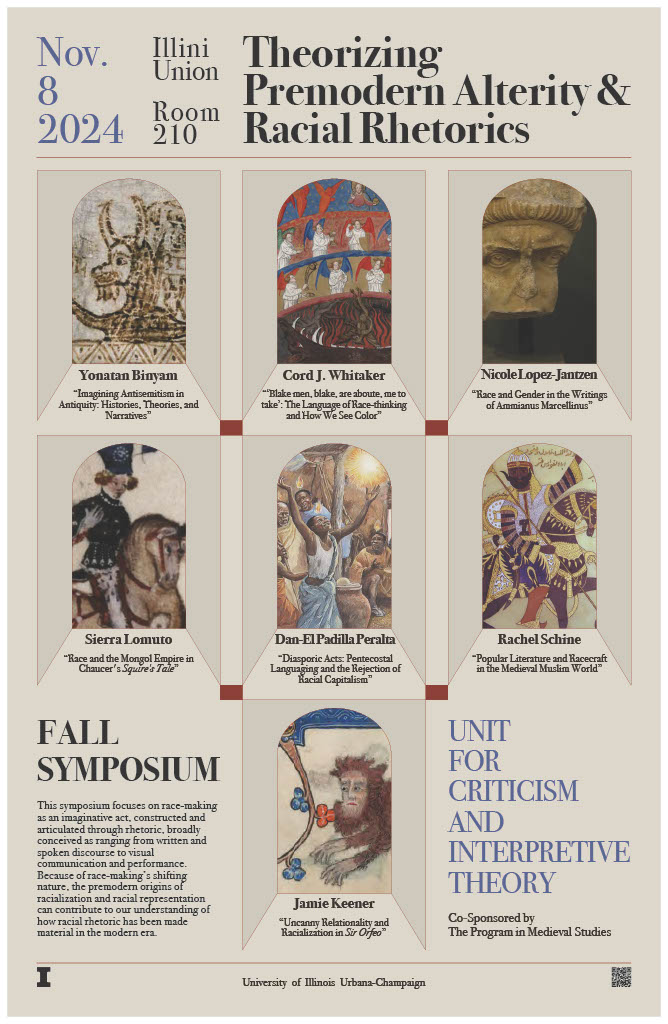
This symposium focuses on race-making as an imaginative act, constructed and articulated through rhetoric, broadly conceived as ranging from written and spoken discourse to visual communication and
If the Unit for Criticism has served as an important venue or source of support for you through its conferences, publications, workshops, seminars, or fellowships, we invite you to invest in the Un
Ann Xiaoxu Pei is a PhD student in Comparative and World Literature program at University of Illinois, Urbana-Champaign. She works at the intersection of environmental humanities and memory studies,...
Kelsi Quick is a PhD student in the Political Science Department at the UIUC and a Research Assistant at the European Union Center. She has a strong interest in exploring the tension between the...
This seminar introduces graduate students to theory, broadly construed. We will move through diverse texts to offer a range of contemporary theories about race, gender, literature, environment, indigeneity, and other matters. Throughout the semester we will ask ourselves “what is theory?” and, no doubt, come up with multiple answers.
Professor Rebecca Oh
Thurs, 12:30 - 02:50 PM
Genre and infrastructure are both structuring forms that shape how things will go. Generic properties shape emplotment, likely or unlikely events, types of characters, and readerly expectations; genre organizes both narrative elements and the relations between them. Likewise, infrastructures are sociotechnical systems that organize and distribute both things and the relations between them, whether by enabling or blocking the movement of people, ideas, and objects. This seminar will consider the affordances of genre for infrastructure and of...
Lila was selected by the Center for African Studies as a FLAS Fellow to continue advanced study of Bamanankan/Julakan, summer 2024 and academic year 2024-25. Additional accomplishments:At the beginning of this year Lila was invited to participate...
Professor D. Fairchild Ruggles
Thurs, 5:30 - 8:20 PM
The seminar introduces students to the historiography of architecture and landscape by exploring diverse approaches used by historians to understand and interpret the built environment. Reading key texts and attending the weekly MCT lectures, we will investigate conventions of the recent past as well as newer interpretive frameworks and theoretical positions in order to understand a range of possible approaches tohistorical research and writing. As such, we will focus not on the content of history but instead on the...